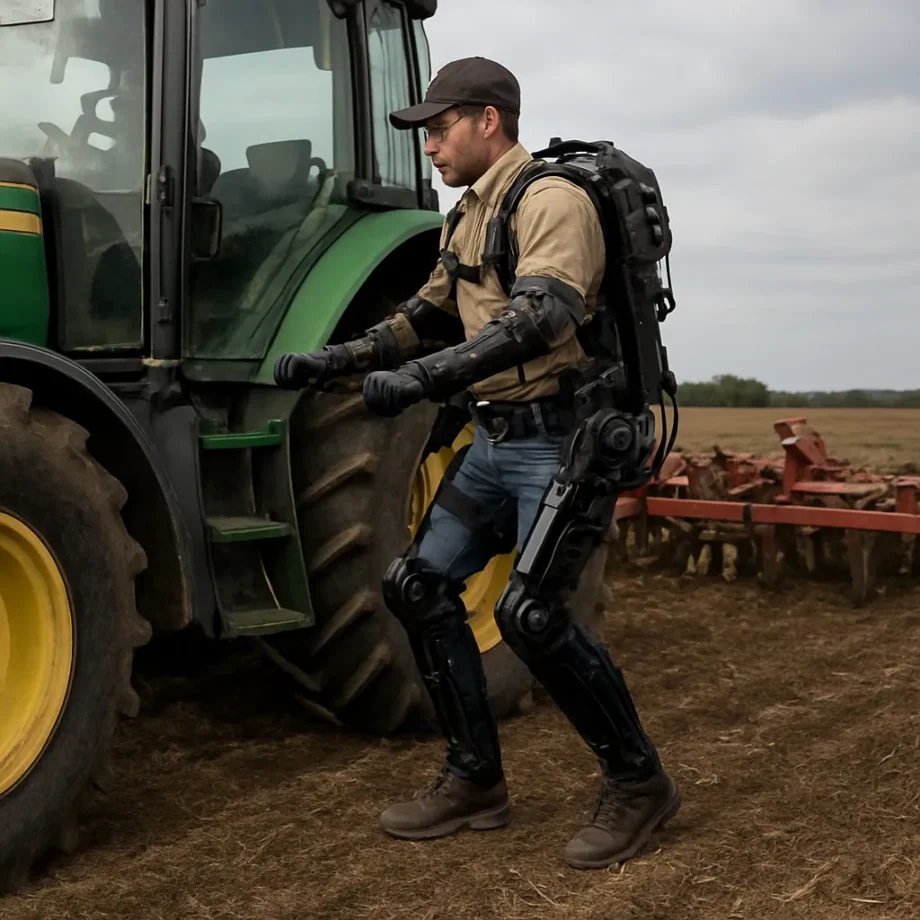
Agricultural machinery has undergone a remarkable transformation over the past century, driving unprecedented gains in efficiency and output. From the first gasoline-powered tractors to today’s GPS-guided harvesters, technology has reshaped farm operations. Yet as equipment grows larger and more complex, operators face physical strain and safety risks that threaten both human health and overall productivity. Emerging wearable robotics—specifically powered exoskeletons—offer a promising solution to mitigate heavy-lifting and repetitive stress. By integrating these devices into daily workflows, farmers can achieve new levels of precision and comfort without sacrificing performance. This article explores the evolution of agricultural machinery, examines the challenges that heavy equipment poses, and outlines how exoskeleton technology could redefine modern farming practices.
Evolution of Agricultural Machinery
Over the last hundred years, farm equipment has evolved from simple implements to multi-functional machines packed with sensors, actuators, and onboard computers. Innovations in automation and hydraulics enabled the first self-propelled combines in the 1930s, while the advent of electronic controls in the 1970s paved the way for precision planting and variable-rate fertilizer application. Today’s smart tractors coordinate seamlessly with drones, soil moisture probes, and cloud-based farm-management platforms. This level of connectivity ensures that fields receive exact amounts of seed, nutrients, and water, reducing waste and promoting sustainability. Despite these breakthroughs, the human operator remains central to critical decisions, from navigating uneven terrain to performing maintenance tasks that demand manual effort and endurance.
Challenges Posed by Heavy Equipment Operation
Handling large machinery involves extended periods of sitting, constant vibration, and forceful manual adjustments. Operators frequently climb on and off tractors, wrestle with heavy attachments, and tighten or loosen bolts by hand. Over time, these activities can lead to cumulative trauma disorders, chronic back pain, and fatigue-induced errors. In addition, maneuvering a multi-ton harvester or front-end loader in adverse weather conditions introduces safety hazards that affect both the operator and surrounding workers. Reducing occupational injuries is critical for maintaining workforce wellbeing and minimizing downtime. Achieving this goal demands a focus not only on machine design but also on augmenting human capability through wearable technology and improved ergonomics.
Exoskeleton Technology in Agriculture
Powered and passive exoskeletons are emerging as transformational tools for industrial and medical applications, and their adaptation to farming is a logical next step. A powered exoskeleton employs electric motors or pneumatic actuators to supplement a user’s strength, while passive models use spring-loaded elements to redistribute loads and support key joints. Farmers using a lower-body exoskeleton may find that lifting heavy grain sacks or adjusting planter hitches requires significantly less effort. Upper-body systems can relieve shoulder and back strain during repetitive tasks such as hose handling and engine maintenance. Early trials have shown that wearable robotics can increase a worker’s endurance by up to 40 percent, leading to higher productivity and reduced risk of musculoskeletal injury.
- Enhanced lifting capacity for heavy implements
- Reduced muscle fatigue during long shifts
- Improved posture and joint protection
- Seamless integration with existing safety gear
Implementing Safety and Ergonomics
For exoskeletons to gain widespread adoption on farms, they must be comfortable, intuitive, and compatible with agricultural workflows. Rigorous ergonomic assessments are crucial to ensure that these devices do not impede movement or introduce new pressure points. Manufacturers are experimenting with adjustable harnesses, quick-release fittings, and modular attachments tailored to specific tasks like harvesting, baling, or machinery repair. Furthermore, real-time sensors embedded in the suit can monitor muscle activity and posture, providing feedback to help operators correct form and avoid risky behaviors. By training workers on proper usage and maintenance, agribusinesses can foster a culture of safety and leverage data analytics to drive continuous innovation in exoskeleton design.
Future Innovations and Trends
The intersection of robotics, data science, and human factors engineering promises to revolutionize the role of the operator in the agricultural sector. Advanced exoskeletons will likely feature machine-learning algorithms that adapt assistance levels based on terrain, task complexity, and the user’s fatigue profile. Integration with autonomous vehicles could enable semi-automated field operations, wherein a single person supervises multiple machines with minimal physical strain. Biometric monitoring—tracking heart rate, muscle exertion, and stress indicators—could further personalize support, ensuring optimal balance between human effort and mechanical aid. Such systems will enhance workforce resilience and fortify rural labor pools against demographic shifts and skill shortages.
Key research directions:
- Battery and power-density improvements for extended field use
- Lightweight materials to minimize metabolic cost
- Open architectures for third-party attachments
- Regulatory frameworks to certify wearable safety devices
The synergy between cutting-edge machinery and human-centered exoskeletons will define the next era of farm mechanization. As farmers strive to meet global demands for food and fiber, wearable robotics offer a path to greater yields, safer work environments, and enhanced quality of life in agricultural communities.