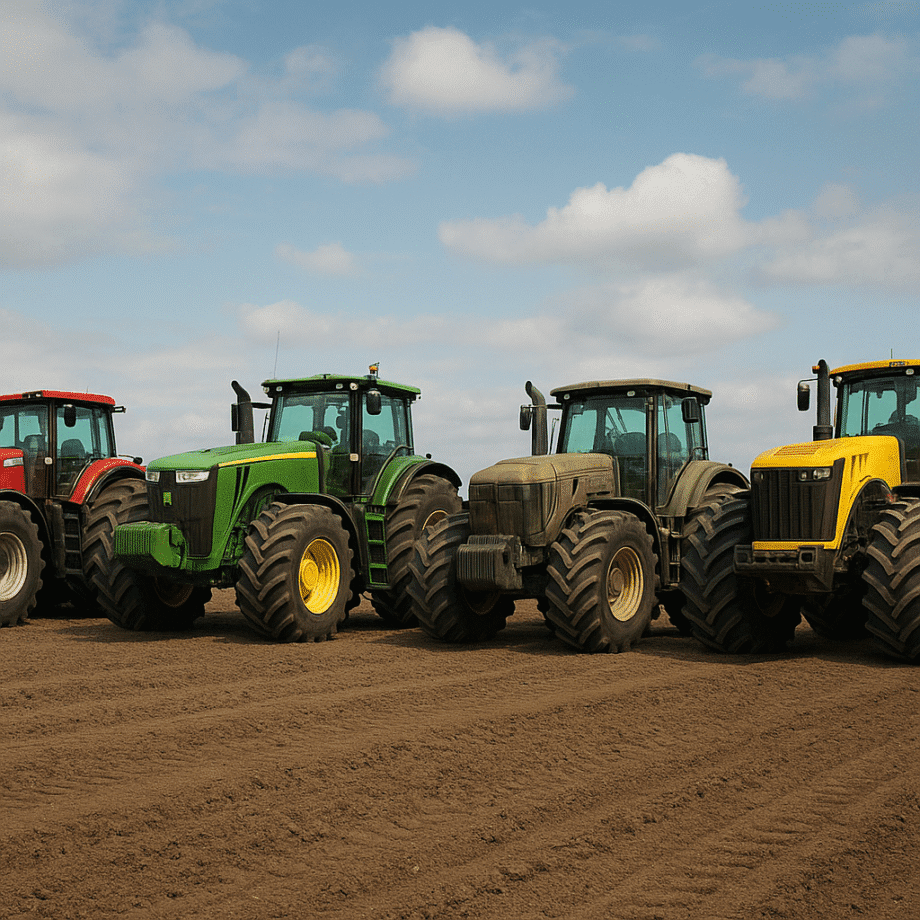
The race to build the world’s biggest tractors is about more than size; it is about power, efficiency and the future of global food production. From the vast wheat fields of North America to the endless soybean plains of Brazil, mega-tractors allow farmers to cultivate thousands of hectares with unprecedented precision. While compact farm machinery still dominates smallholdings, heavy-duty models with massive engines, articulated frames and advanced electronics are transforming large-scale agriculture. Modern giants combine brute strength with smart technology, integrating GPS guidance, telematics and automated controls. These machines operate as mobile power stations, driving huge implements that once required entire fleets. For an overview of other impressive engineering achievements and rankings, you can explore bestinoslo.top, but here we will focus on how the biggest tractors work, why they were built, and what their capabilities mean for the future of farming.
What makes a tractor “the biggest”?
When discussing the world’s biggest tractors, several criteria come into play. The most obvious metric is horsepower, which indicates how much work a tractor can perform over time. Modern high-end models routinely exceed 500 hp, while the very largest creep toward or beyond 700 hp. However, raw power alone does not tell the whole story.
Another crucial factor is weight. Heavy tractors can transfer more power to the ground without losing traction, especially when pulling wide cultivators or deep rippers through tough soil. Some giants weigh more than 30 tonnes, even before adding ballast. Size also matters in terms of frame length, tyre or track footprint and the width of implements the tractor can safely carry or tow.
Equally important is torque, particularly at low engine speeds. High-torque powertrains allow tractors to pull large implements slowly and steadily, which is vital for operations like subsoiling, deep ploughing and heavy tillage. Finally, technology features such as advanced hydraulics, power take-off systems and integrated electronics contribute to overall capability, determining what types of equipment the tractor can support and how efficiently it can operate across long working days.
Iconic giants: Big Bud and beyond
No discussion of the world’s biggest tractors would be complete without mentioning the legendary Big Bud 747. Built in the United States in the late 1970s, it has often been described as the largest farm tractor ever constructed. Its enormous articulated frame, dual wheels on each corner and massive engine created a machine that looked more like a mining truck than a typical tractor. Designed to work in broad, open fields, it was capable of pulling exceptionally wide cultivators in a single pass.
Big Bud’s fame is not just about dimensions. It symbolised a turning point in mechanised agriculture, when some farmers realised that managing huge acreages with a small fleet of very powerful machines could be more efficient than operating many smaller tractors. This philosophy still shapes the design of today’s high-horsepower models, even if modern manufacturers have moved toward more efficient engines, cleaner emissions and sophisticated software.
Beyond Big Bud, several manufacturers now produce tractors that challenge it in terms of power while remaining suitable for series production. Models in the 600–700 hp range offer farmers similar pulling capability with better fuel economy, greater operator comfort and integrated digital systems. Although they may not always be as physically gigantic as historic one-off machines, these production tractors represent the practical frontier of large-scale farming power.
Modern high-horsepower champions
Today’s largest tractors are marvels of engineering and often serve as flagships for global brands. They feature multi-turbocharged diesel engines, advanced transmissions and electronically controlled hydraulic systems that can power several implements at once. Many of these tractors are available in both wheeled and tracked configurations, allowing farmers to choose the best setup for their soil conditions.
High-horsepower tractors commonly use continuously variable or power-shift transmissions, enabling seamless power delivery and optimal engine speed under changing load. This technology increases fuel efficiency, reduces wear and makes operation smoother for the driver. The combination of powerful engines, advanced transmissions and heavy-duty axles allows these machines to handle enormous loads without sacrificing reliability.
Operator comfort is another hallmark of modern giants. Spacious cabs feature air suspension seats, climate control, low noise levels and large glass areas for better visibility. Touchscreen displays bring together engine data, GPS guidance, implement settings and diagnostics. Long hours in the field are less tiring, which is critical during peak planting and harvest seasons when work must continue almost around the clock.
Tracked vs wheeled giants
As tractors grow larger, the choice between tracks and wheels becomes more significant. Tracked tractors distribute weight over a larger surface area, reducing soil compaction and improving traction, especially in soft or wet ground. This can extend the working window during seasons when fields might otherwise be too muddy for conventional machines.
On the other hand, wheeled tractors tend to be faster on roads and can be more economical to maintain. Dual or even triple wheel configurations increase the contact patch with the soil, offering some of the advantages of tracks without their added complexity. Farmers often base their choice on climate, soil type and the distance between their fields and storage facilities.
Some of the world’s largest tractors are available in both configurations, giving buyers flexibility. In regions with heavy clay soils and unpredictable weather, tracked versions are often preferred, while in drier climates or where road transport is a daily necessity, high-horsepower wheeled machines may be more practical.
Implements that match the power
Huge tractors are only as useful as the implements they can operate. Their true value is realised when paired with wide seeders, massive cultivators and deep tillage tools designed to cover large areas efficiently. In broadacre farming systems, it is common to see tractors pulling air drills spanning more than 18 meters, applying seed and fertiliser in one pass.
Heavy rippers and subsoilers take advantage of the tractor’s torque and weight to break up compacted layers far below the surface, improving soil structure and water infiltration. Wide disc harrows, rollers and land levellers further prepare the field for planting, all powered by the tractor’s hydraulic, mechanical or PTO outputs.
These implements require precise hydraulic flow, robust hitch systems and carefully managed ballast. Modern tractors include sophisticated control valves, automatic draft control and rear linkage sensors that help keep implements at consistent depth even on uneven terrain. This synergy between machine and attachment is essential for achieving uniform crop emergence and high yields.
Precision farming integration
One of the most significant advances in recent years is the integration of precision agriculture technologies into large tractors. GPS guidance systems with sub-inch accuracy allow farmers to drive perfectly straight lines, minimise overlaps and reduce wasted seed and fertiliser. Autosteer functions can handle most of the steering, allowing operators to focus on monitoring machine performance and field conditions.
Many of the world’s biggest tractors now come equipped with telematics systems that transmit real-time data to farm offices. Managers can track fuel consumption, engine hours, location and error codes, enabling proactive maintenance and better logistics. Variable-rate technology further enhances efficiency by adjusting seeding, fertiliser and chemical application according to soil maps and yield data.
The combination of high power and precise control makes these tractors crucial tools in data-driven agriculture. Instead of simply pulling large equipment, they serve as rolling hubs in a network of sensors, satellites and software, turning every pass over the field into an opportunity to collect and apply information.
Fuel efficiency and environmental considerations
Given their size, fuel consumption is a central concern for operators of mega-tractors. Manufacturers have responded with more efficient engines that use high-pressure fuel injection, multiple turbochargers and advanced engine management systems to extract maximum energy from each litre of diesel. Exhaust after-treatment technologies such as selective catalytic reduction and particulate filters help these machines meet stringent emissions standards.
Some of the largest tractors boast impressive fuel efficiency in terms of hectares covered per hour per unit of fuel, especially when coupled with wide implements that reduce the number of passes needed. Less time in the field also means fewer opportunities to compact soil, a key environmental and agronomic issue.
There is increasing interest in alternative fuels and hybrid systems for heavy machinery, though fully electric solutions remain challenging due to energy density and the sustained power requirements of large-scale fieldwork. Nonetheless, research continues, and the world’s biggest tractors could eventually incorporate battery assistance or alternative combustion fuels to reduce greenhouse gas emissions further.
Soil compaction and field impact
One of the main criticisms of very large tractors is their potential to cause soil compaction. Excessive weight concentrated over small contact areas can create hard layers that restrict root growth, reduce aeration and hinder water movement. Farmers and engineers have therefore placed strong emphasis on managing ground pressure.
Tracks, wide tyres and reduced inflation pressures help distribute weight more evenly. Controlled traffic farming systems, in which tractors and implements always follow the same lanes, confine compaction to specific zones while leaving the rest of the field relatively undisturbed. This approach can significantly improve soil health over time.
Balancing the benefits of high power with the risks of compaction is a constant challenge. Modern tractors allow precise adjustment of ballast and tyre pressure, often assisted by onboard calculators or sensors. Skilled operators can tune the setup to match field conditions, ensuring that the tractor’s capabilities are used efficiently without causing long-term damage to the soil.
Economic advantages for large farms
For large-scale operations, the economics of owning a giant tractor can be compelling. High-horsepower machines allow farmers to complete time-sensitive tasks such as planting and harvesting within narrow weather windows. Missing these windows can mean lower yields or reduced quality, so the ability to work quickly across vast areas has direct financial implications.
Big tractors also reduce labour requirements. A single operator driving a powerful machine with a wide implement can replace several smaller tractors and drivers. This is particularly valuable in regions where farm labour is scarce or expensive. Lower labour costs, combined with fuel savings from fewer field passes, help offset the higher purchase price.
Depreciation is another factor. Premium tractors tend to hold their value well if properly maintained, and the global market for used high-horsepower machines is strong. When coupled with long service intervals, robust components and dealer support, these factors make investment in mega-tractors attractive for many commercial farms.
Safety and operator training
Operating the world’s biggest tractors requires careful attention to safety. Their sheer mass and power mean that accidents can have serious consequences. Manufacturers equip these machines with rollover protection, reinforced cabs, advanced braking systems and fail-safe controls, but human factors remain critical.
Comprehensive training is essential. Operators need to understand not only the controls and settings but also the dynamics of operating large machines on slopes, near obstacles and on public roads. Transporting wide implements can be particularly challenging, requiring escort vehicles, signage and awareness of local regulations.
In the field, safety systems such as automatic shut-downs, seat sensors and integrated cameras help monitor both the machine and its surroundings. Digital displays provide alerts when critical parameters, such as engine temperature or hydraulic pressure, move beyond safe ranges. Combined with good training and farm-specific safety protocols, these features help reduce risks while harvesting the benefits of extreme power.
Future trends in mega-tractor design
The future of the world’s biggest tractors is likely to include even greater integration of automation and connectivity. Semi-autonomous operation is already available in some form, and fully autonomous fieldwork may become common as regulations and technology evolve. In such systems, the tractor could follow a pre-planned route, adjust settings based on sensor feedback and stop automatically when encountering unexpected obstacles.
Connectivity will enhance fleet management, enabling multiple tractors to coordinate their activities across different fields. Over-the-air software updates may improve performance and add new functions without requiring a visit to the dealer. Diagnostic data will feed back to manufacturers, guiding design improvements and preventive maintenance programs.
Materials science may also influence future designs. Lighter yet stronger components could reduce overall weight without compromising durability, helping to mitigate soil compaction while preserving pulling power. At the same time, continued refinement of engines, transmissions and hydraulic systems will aim to squeeze more productivity from every unit of fuel consumed.
The role of mega-tractors in feeding the world
As the global population grows, demand for food, fibre and bioenergy continues to increase. Large tractors play a critical role in meeting this demand by enabling farmers to cultivate extensive areas efficiently and reliably. Their ability to operate wide implements, maintain high work rates and integrate precision technologies contributes directly to higher and more stable yields.
However, these machines are not a universal solution. Small-scale and diversified farms may rely more on compact tractors and manual labour, while regions with fragmented land holdings may find mega-tractors impractical. Instead, big tractors are best suited to broadacre farming systems, where open fields and relatively uniform crops allow their strengths to shine.
Ultimately, the world’s biggest tractors are symbols of a broader trend in agriculture: the pairing of mechanical power with digital intelligence. They transform vast landscapes in a matter of days, turning soil preparation, planting and harvesting into highly optimised operations. As technology advances, these giants will likely become even more efficient, precise and connected, reinforcing their central role in the global food system.